Why Fasteners Loosen In Vibration
Why Fasteners Loosen Under Vibration - and How to Stop It
Fastener loosening under vibration is one of the most common causes of assembly failure in engineering. It is not a sign of poor workmanship; it is a physics problem. Understanding why it happens is the first step to choosing the right locking solution. This guide explains the mechanism behind vibration loosening, the conditions that make it worse, and the specific fastener solutions that prevent it.
Why Vibration Causes Fasteners to Loosen
To understand why assemblies fail under cyclic strain, it is necessary to examine the underlying preload mechanism. When a nut is tightened correctly against a joint, the bolt stretches elastically like a rigid spring. This elastic stretch creates a continuous clamping force known as the preload. The friction generated between the face of the nut, the joint surface, and the mating thread flanks is the only force that resists rotation and maintains this vital clamp load.
Vibration introduces dynamic forces that defeat this frictional balance. Under operations involving lateral or cyclic stress, microscopic transverse slip occurs between the mating threads. Each slip event momentarily cancels out the friction holding the nut in place. When this happens, the nut rotates fractionally in the loosening direction because the elastic tension stored within the bolt is constantly trying to return to its unstretched, natural state. Over thousands of vibration cycles, these tiny, fractional rotations accumulate into significant structural loosening and complete loss of clamping joint integrity.
The Junker transverse vibration test, defined under the international standard DIN 65151, is the globally recognised method for verifying how effectively a fastener resists self-loosening. Unlike generic testing setups, a Junker machine applies direct, cyclic lateral loading perpendicular to the thread axis, which is the most severe and damaging vibration mode encountered in mechanical engineering. By monitoring the dissipation of clamping force over time, the test maps exactly how quickly standard configurations give way to transverse slip.
Certain operating environments cause assemblies to loosen much faster than typical setups. Factors that accelerate this failure include insufficient preload during initial torque installation, smooth joint surfaces with low friction coefficients, intense high-frequency transverse vibration, aggressive thermal cycling that induces differential material expansion, and relying on standard hex nuts without an engineered locking feature.
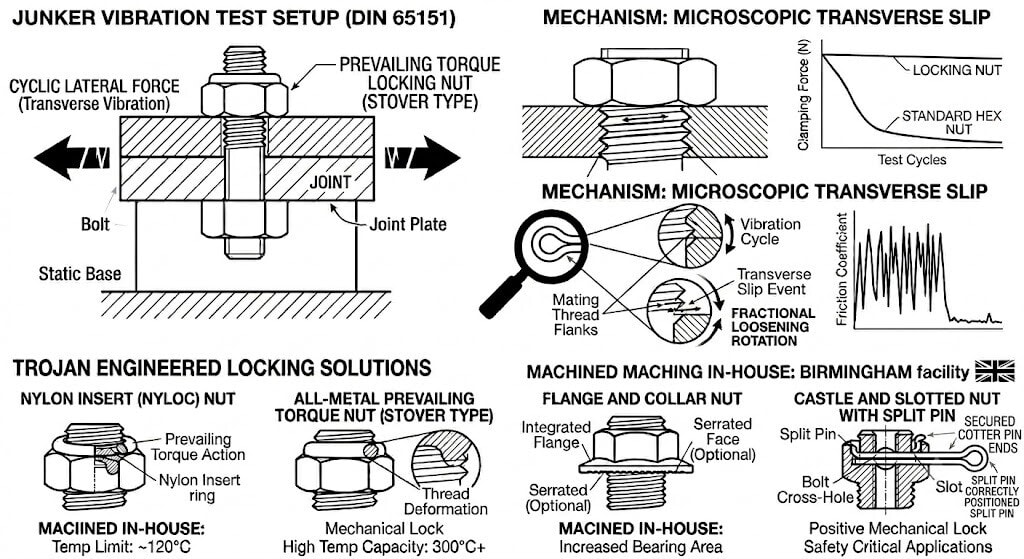
Figure 1: Graphical breakdown of the friction dissipation mechanism during transverse thread slip, alongside the four primary mechanical locking nut profiles precision bar-turned in-house at our Birmingham production facility to prevent vibration loosening.
The Most Common Vibration Loosening Scenarios
Engineers and maintenance teams often look for diagnostic patterns when a component fails. Recognizing where cyclic stress concentrates helps identify why standard hardware falls short:
- Automotive and commercial vehicle applications: Wheel nuts, axle shafts, and heavy suspension fasteners are subject to constant, low-frequency road vibration. Loosening in these systems rapidly leads to wheel detachment or catastrophic structural failure.
- Industrial machinery and plant equipment: High-speed rotating machinery transmits continuous high-frequency vibration through its structural mountings. Fasteners used inside bearing housings, industrial gearboxes, and heavy pump assemblies are particularly vulnerable to quick loss of preload.
- Railway rolling stock: Bogie assemblies and trackside systems undergo intense, continuous track-induced vibration over long, uninterrupted service periods. Fastener compliance standards across the railway sector remain among the most stringent in the world.
- Agricultural and construction equipment: Heavy shock loads combine with severe, irregular vibration caused by operating across rough terrain. Standard non-locking fasteners loosen rapidly under these structural forces without a dedicated mechanical locking feature.
- Aerospace and defence installations: The consequences of an assembly failing in mid-flight are severe. Positive mechanical locking solutions, such as castle nuts secured with split pins or all-metal prevailing torque nuts, are strictly mandatory across most flight specifications.
- HVAC and building services: Large fan installations and industrial pump mountings transmit persistent operational harmonics directly to structural ceiling fixings. These joints are often overlooked during routine maintenance schedules until a secondary fitting works loose.
The Right Locking Solution for Your Application
Selecting the correct hardware profile requires matching the physical mechanics of the nut to the specific operational environment. As an established British manufacturer, Trojan machines every mechanical solution detailed below from solid bar stock to exact engineering drawings.
Nylon Insert Locking Nuts (Nyloc Nuts)
How they work: A tough nylon collar insert is captured inside the top section of the nut profile. As the mating male bolt thread passes through this collar, the nylon deforms elastically around the threads. This creates a predictable friction force known as prevailing torque, a continuous resistance to rotation that remains active even if the primary joint preload drops to zero. This friction keeps the nut firmly anchored under steady vibration cycles.
Governing Standards: Manufactured in compliance with DIN 982 (full heavy nut), DIN 985 (thin low-profile nut), DIN 6924 (flange nyloc), ISO 7040, ISO 7041, BS 4929, and ASME B18/B16 parameters.
When to use: Excellent for general engineering vibration applications. They are effective against medium-frequency vibration, simple to install with standard workshop tools, and reusable for a limited number of assembly cycles.
Limitations: The integrated nylon element begins to degrade and lose its structural integrity at temperatures exceeding approximately 120°C. They are not suitable for high-temperature exhaust or furnace environments, and they cannot be reused indefinitely since the internal nylon paths wear down over repeated installations.
Trojan manufactures precision bar-turned nylon insert locking nuts from M3 up to M52 in metric sizes alongside all imperial equivalents, stocking mild steel, stainless steel (304 and 316), and free-cutting brass options.
All-Metal Prevailing Torque Nuts (Stover Type)
How they work: The top threads of the nut profile are permanently modified, either by engineering a precise mechanical oval deformation or by running a localized thread-distortion process. This distortion creates a tough, all-metal mechanical grip against the bolt threads. Because the locking action is entirely mechanical and contains no non-metallic inserts, it does not rely on synthetic elements and maintains its friction holding power at elevated temperatures.
Governing Standards: Produced to meet DIN 980, ASME B18.16.6, and ISO 7042 international engineering specifications.
When to use: Ideal for high-temperature environments where standard synthetic inserts would soften or melt. They are widely specified across aerospace, defense, and heavy exhaust assemblies requiring reliable reusability and durable operational performance across multiple maintenance cycles.
Trojan supplies all-metal prevailing torque nuts, including Stover-type and specialized thread-distorted profiles, across our full range from M3 to M52 in metric, machined in mild steel, high-tensile steel alloys, and grades 304 and 316 stainless steel.
Flange and Collar Nuts
How they work: An integral, wide circular flange base expands the overall surface area of the fastener. This expansion distributes the clamping force across a larger bearing seat, which increases the total amount of face friction holding the nut in place. Serrated variant faces go a step further by adding directional teeth that bite directly into the face of the joint surface, physically resisting rotation in the loosening direction.
When to use: Highly effective when fastening soft materials, assembly lines where handling separate washers is inefficient, or joints requiring distributed surface loads. Non-serrated faces are preferred when the mating component face must not be marked or scratched during assembly.
Limitations: Serrated variants cannot be used against hardened washers or treated steel structures, as the teeth cannot bite into the surface. They do not provide a positive physical lock against extreme transverse vibration; for severe duty, they should be paired with an additional locking feature.
We manufacture custom flange and collar nuts across specialized diameters and non-standard face thicknesses turned straight from solid metal bar stock to meet your project specifications.
Castle and Slotted Nuts with Split Pins
How they work: The upper section of the nut features a castellated collar with vertical slots precision-machined across the flats. The nut is tightened to its target torque value, and a split pin (cotter pin) is passed directly through a pre-drilled cross hole in the bolt shaft and through the matching slots of the nut. This creates a positive physical barrier. The nut is physically prevented from rotating, regardless of friction levels or changes in joint preload.
When to use: Mandatory across critical safety junctions where operational failure cannot be risked, including automotive steering columns, heavy suspension joints, railway axles, and aircraft linkages. It remains the only option that delivers a positive mechanical lock independent of torque retention or surface friction values.
Limitations: Installation requires precise alignment between the machined slots and the pre-drilled hole in the bolt shaft at final torque. This makes them unsuitable for fast assembly lines or setups requiring frequent adjustments, and a new split pin must be installed every time the joint is disassembled.
Trojan manufactures castle and slotted nuts featuring 2, 4, 6, 8, or 12 slots across standard and bespoke dimensions, turned from mild steel, high-tensile alloys, stainless steel, and brass bar stock.
Prevailing Torque Flange Nuts (Combined Solutions)
How they work: This high-performance configuration combines the large surface bearing area of an integral base flange with the reliable rotation resistance of a nylon or all-metal prevailing torque locking feature. By utilizing two independent friction mechanisms at once, it offers excellent resistance against intense vibration in automotive chassis builds and heavy industrial processing machinery.
We regularly manufacture prevailing torque flange nuts as bespoke items machined to custom engineering prints, making this a common special request for targeted industrial applications.
Chemical Thread-Locking Adhesives (Contextual Reference)
For complete engineering context, liquid thread-locking chemical compounds (such as Loctite) are frequently used across general assembly work. However, these are chemical solutions rather than mechanical components. They are generally unsuited for applications requiring regular field disassembly, assemblies exposed to high operational temperatures, or heavy specifications where a positive mechanical lock is strictly required. For robust industrial engineering, a precision-machined mechanical nut remains the standard choice.
Comparison of Vibration Locking Solutions
This technical matrix outlines the operational limits, reuse capacities, and primary engineering applications for each fastening method:
| Locking Method | Temperature Limit | Reusable | Positive Lock | Best For |
|---|---|---|---|---|
| Nylon Insert (Nyloc) | Up to ~120°C | Limited Cycles | No | General engineering, medium vibration environments |
| All-Metal Prevailing Torque | 300°C+ (Material Dependent) | Yes | No | High-temperature zones, aerospace, repeat maintenance |
| Serrated Flange Nut | No Thermal Limit | Yes | No | Soft mating surfaces, medium vibration lines |
| Castle Nut + Split Pin | No Thermal Limit | Replace Split Pin | Yes | Safety-critical linkages, steering, railway systems |
| PT Flange Nut (Combined) | Insert Dependent | Limited Cycles | No | Automotive chassis, high surface load assemblies |
| Thread-Locking Adhesive | ~150°C to 200°C max | No | No | Low-cost commodity assemblies, permanent fixtures |
How to Specify the Right Locking Nut
When selecting fasteners for a high-vibration assembly, engineers should evaluate five core criteria before specifying hardware parameters:
1. Identify the Continuous Operating Temperature
If your joint runs at temperatures above 120°C, synthetic inserts will degrade and lose effectiveness. For these applications, specify all-metal prevailing torque styles or mechanical castle nut options.
2. Assess Safety-Critical Design Risk
Suspension linkages, steering systems, aerospace mechanisms, and rail infrastructure require positive mechanical retention that stays secure even if joint friction drops. Specify castle nuts paired with premium split pins for these setups.
3. Evaluate Maintenance and Disassembly Frequency
Nyloc collars lose locking force after repeated removal cycles. If your equipment requires regular teardowns for internal maintenance, all-metal prevailing torque nuts maintain their mechanical locking force over more cycles.
4. Define the Required Thread Form and Pitch
While standard metric and imperial sizes can be sourced from general stock, non-standard thread pitches, left-hand threads, BSW, BSF, or legacy BA profiles require a specialist manufacturing partner with flexible tooling setups.
5. Match the Material Grade to the Operating Environment
Corrosive marine or chemical processing environments require high-grade stainless steel locking nuts, while heavy structural joints require high-tensile all-metal prevailing torque nuts to withstand high clamping loads. Always check for material tracking compliance; Trojan provides full EN 10204 3.1 material certification across our orders.
If you are designing an assembly and require guidance on thread specification or material selection, our technical team is available to help. We have been manufacturing precision bar-turned fasteners and custom locking solutions in the West Midlands since 1991. Review our technical data or read our comprehensive finishes guide to ensure total atmospheric protection for your parts.
Frequently Asked Questions
A: Vibration causes microscopic transverse slip between the mating surfaces of a bolted joint. Each slip event momentarily reduces the friction holding the nut in place, allowing it to rotate fractionally in the loosening direction. The elastic tension in the bolt always acts to return the fastener to its unstretched state, so each vibration cycle produces a tiny rotational movement. Over thousands of cycles these accumulate into significant loosening and eventual loss of preload.
A: The best choice depends on the application. For general engineering vibration, nylon insert locking nuts (nyloc nuts) to DIN 982 or DIN 985 are effective and widely used. For high-temperature applications or where all-metal construction is required, all-metal prevailing torque nuts to DIN 980 are the correct choice. For safety-critical applications - steering, suspension, aerospace, and railway - castle and slotted nuts with split pins provide a positive mechanical lock that is independent of friction.
A: A nyloc nut uses a nylon insert to create a prevailing torque by gripping the bolt thread. It is effective up to approximately 120°C and has limited reusability. An all-metal prevailing torque nut uses a deformed metal thread section to create the same effect without any nylon. It is effective at temperatures above 120°C, is more durable over repeated assembly cycles, and is required in applications where non-metallic materials are not permitted.
A: A serrated flange nut improves vibration resistance by increasing the bearing area and adding a mechanical bite against the joint surface. It is effective in medium-vibration applications. For severe vibration, a flange nut with a prevailing torque feature - combining both mechanisms - is a more reliable solution. For safety-critical applications, a positive locking solution such as a castle nut with split pin is required.
A: The most common causes are: using a standard nut without a locking feature in a vibration environment; insufficient preload at installation (under-torquing); a smooth joint surface with low friction; high-frequency transverse vibration exceeding the friction capacity of the joint; and thermal cycling causing differential expansion that reduces preload. The solution is to specify the correct locking nut for the vibration level and temperature, and to ensure correct installation torque.
A: The Junker test, defined in DIN 65151, is the recognised method for testing fastener resistance to vibration loosening. It applies transverse cyclic loading - the most severe vibration mode - and measures preload loss over a set number of cycles. Fasteners that maintain preload under Junker testing conditions are considered vibration-resistant.
A: Yes. Trojan manufactures nylon insert locking nuts, all-metal prevailing torque nuts, flange and collar nuts, and castle and slotted nuts in non-standard sizes, unusual thread forms, and bespoke materials to customer drawings or samples. There is no minimum order quantity.
Need Locking Nuts for a Vibration Application?
Trojan manufactures nyloc nuts, all-metal prevailing torque nuts, flange nuts, and castle nuts in standard and non-standard sizes. Same-day quotations. No minimum order. UK manufacturer.
Call +44 (0)121 789 8586 or use our contact form. Manufactured directly in Birmingham.
Request a QuoteTrojan Special Fasteners Limited
18 Fortnum Close, Tile Cross, Birmingham, B33 0LG, United Kingdom
Tel: +44 (0)121 789 8586 | Web: trojansf.co.uk
Precision In-House Turning & Custom Locking Solutions Since 1991