

Washers
Trojan Special Fasteners Ltd routinely manufactures plain flat washers to customer’s requirements in multiple material and finish combinations.
A washer is usually a thin, flat disk-shaped component with a hole in the centre, which is used to distribute the load of a fastener, such as a bolt or screw. The washer is placed between the nut and the material being fastened, and it helps to prevent the fastener from becoming loose over time due to vibration or other factors.
Washers can be made from a variety of materials, including steel, stainless steel, brass, copper, nylon, and plastic. The choice of material will depend on the specific application and the properties required, such as corrosion resistance, strength, or flexibility.
There are many different types of washers available, each designed for specific applications. Some common types of washers include:
Flat washers: These are the most basic type of washer, and they have a simple flat shape with a hole in the centre.
Spring washers: These washers are designed to provide a spring-like action, which helps to maintain tension on the fastener over time.
Lock washers: These washers are used to prevent the fastener from becoming loose due to vibration. They are often used in conjunction with a nut or bolt.
Belleville washers: These are conical-shaped washers that provide a high load capacity and can be used to compensate for thermal expansion or contraction.
Wave washers: These washers have a wave-like shape and are used to provide a cushioning effect or to compensate for misalignment.
In a bolted assembly, the washer is typically placed between the nut and the material being fastened. The washer should be sized appropriately for the fastener and the application to ensure proper load distribution and fastener retention. The washer is usually held in place by friction, but some types of washers may have a locking feature or require special assembly techniques.
Washers are typically used to increase the bearing surface of a fastener. This provides increased surface area for a fastener and compensates for oddly sized or shaped holes. The addition of a washer to a nut and bolt assembly will resist loosening.
Washers are also used to distribute force so that mating surfaces are not damaged by nuts, especially square unchamfered nuts which have very sharp edges.
In addition to standard preferred sizes, we also manufacture non standard and non preferred sizes.
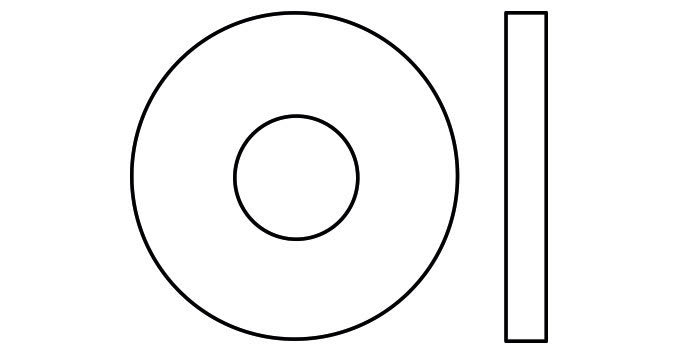
Unchamfered
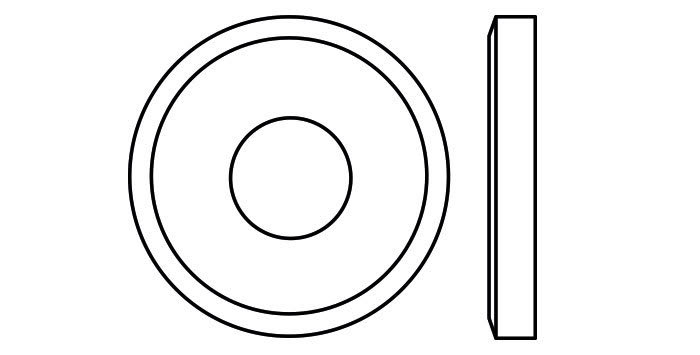
Single Chamfered
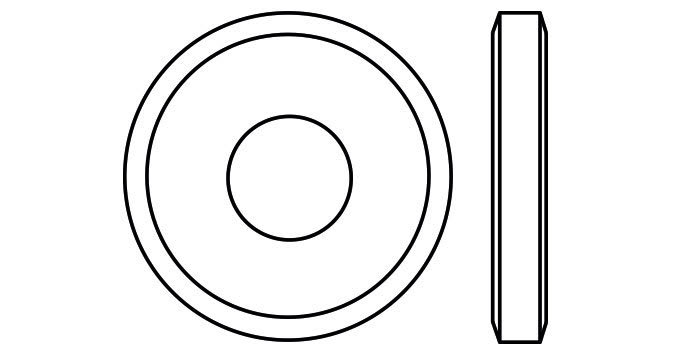
Double Chamfered
The Engineering Science of Washers, Spacers and Bosses
What is a Washer?
A washer is a precision-engineered disc, typically annular (ring-shaped) in form, with a central hole sized to pass a fastener shank whilst the outer diameter is large enough to bear against the parent material or nut face. In its simplest form, a flat plain washer is a deceptively simple component - yet it performs a critical mechanical function that determines whether a bolted joint will remain secure for the life of an assembly or fail prematurely.
The word "washer" likely derives from the Old English waescan or the German waschen, though its mechanical use predates reliable etymology. What is certain is that washers have been used in engineering assemblies for at least three centuries, and their importance has only grown as design loads and reliability expectations have increased.
Trojan Special Fasteners Ltd manufactures plain flat washers, chamfered washers, and spacer components to customer requirements. Unlike stamped washers produced from sheet material - which dominate the commodity market - our washers are bar-turned on CNC lathes from solid bar stock. This gives them superior dimensional accuracy, tighter tolerances, better surface finish, and more consistent mechanical properties than their stamped counterparts. We can also manufacture to any custom dimension, in virtually any machinable material.
What is a Spacer?
A spacer is a cylindrical or tubular component, manufactured to a precise length and bore diameter, used to maintain a defined separation distance between two components in an assembly. Spacers may be unthreaded (plain bore) or threaded internally, and may be plain-ended or feature chamfers, counterbores, or other functional geometry.
The distinction between a washer and a spacer is primarily one of proportion. A washer is characterised by having an axial thickness (length) considerably less than its outside diameter - it is essentially flat. A spacer has an axial length that equals or exceeds its outside diameter - it is taller than it is wide, or at minimum comparable in both dimensions.
Spacers are used in:
- Bearing arrangements - to set axial preload or end-float
- Shaft assemblies - to position gears, pulleys, and sprockets at correct axial locations
- Structural steelwork - to pack out gaps between components
- Electronic assemblies - to maintain precise clearances between PCBs or housings
- Automotive applications - to set brake caliper positions, adjust kingpin geometry, or space out hubs
- Railway rolling stock - to set wheel-back-to-back dimensions or axle end-float
What is a Boss?
A boss (sometimes called a boss nut, round nut, or barrel nut) is a cylindrical internally threaded component, produced from round bar, that is tightened by spanner engagement with holes, slots, or cross-holes drilled radially, or by hand if torque requirements permit. A boss may also refer to a solid (unthreaded) protrusion machined integrally into a casting or fabrication to provide a flat, accurately located bearing surface for a fastener.
In fastener terminology as used by Trojan, bosses are bar-turned round components that may be:
- Threaded through the full length (functioning as a round nut or connector)
- Threaded part-length with a plain spigot portion
- Plain-bored spacers with accurately machined faces
- Counterbored to accept a fastener head
- Drilled and tapped for a grub screw locking feature
Bosses are common in:
- Steam engine and boiler work - where round bosses are used on valve covers, inspection ports, and cylinder flanges
- Hydraulic and pneumatic assemblies - where a boss provides a flat, machined seating face for a component
- Precision machinery - where the cylindrical form can be located accurately in a bore
- Heritage and restoration projects - where original round nut forms must be reproduced faithfully
The Physics of Load Distribution: Why Washers Matter
The Bearing Stress Problem
When a nut is tightened onto a bolt, the clamping force (the preload) is transmitted from the nut face through the joint interface. The nut face bears against whatever surface is beneath it - whether that is the clamped component itself, or a washer placed between nut and component.
The critical engineering quantity is bearing stress, defined as the force per unit area acting perpendicular to a surface:
Bearing Stress (sigmab) = F / A_
Where:
- F is the applied clamping force in Newtons (N)
- A is the bearing area in square millimetres (mm2)
- sigma_b is the resulting bearing stress in Newtons per square millimetre (N/mm2), numerically equal to MPa
If the bearing stress exceeds the compressive yield strength of the softer material in contact, that material will plastically deform - it will crush, indent, or embed. This causes the joint to lose preload, and the fastener will become loose.
Calculating Bearing Area: Nut Face Alone vs Nut Face with Washer
The bearing area of a standard hexagon nut face is the annular ring between the thread bore and the wrench flat circle. For a standard metric nut, the approximate bearing area can be calculated as:
Anut = pi/4 x (Dw2 - dh2)_
Where:
- D_w = washer face diameter (approximately 0.9 x wrench flat dimension for a standard nut)
- d_h = hole diameter (approximately 1.1 x nominal thread diameter)
For a plain flat washer, the bearing area is simply:
Awasher = pi/4 x (OD2 - ID2)_
The effective bearing area available to distribute the clamping force is therefore dramatically increased by the addition of a washer.
Worked Example: M12 Bolt on Aluminium
Consider an M12 grade 8.8 bolt tightened to its proof load of approximately 59,000 N (59 kN). The parent material is aluminium alloy 6082-T6, with a compressive yield strength of approximately 260 N/mm2.
Without a washer:
- Standard M12 hex nut washer face diameter: approximately 17.8 mm
- Hole diameter through aluminium: 13 mm (standard clearance hole for M12)
- Bearing area = pi/4 x (17.82 - 132) = pi/4 x (316.84 - 169) = pi/4 x 147.84 = 116.1 mm2
- Bearing stress = 59,000 / 116.1 = 508 N/mm2
- This is 1.96 times the yield strength of the aluminium - the surface will crush and indent severely
With an ISO 7093 Large Series M12 washer (OD 37 mm, ID 13.5 mm):
- Bearing area = pi/4 x (372 - 13.52) = pi/4 x (1369 - 182.25) = pi/4 x 1186.75 = 931.8 mm2
- Bearing stress = 59,000 / 931.8 = 63.3 N/mm2
- This is well below the yield strength of the aluminium at 260 N/mm2 - the surface is safe
The washer in this example reduces bearing stress by a factor of 8.0 times (800% reduction). The difference between joint failure and joint integrity is a single washer costing a fraction of a penny.
Summary Table: Bearing Stress Comparison for M12 Bolt at 59 kN Preload
| Configuration | Bearing Area (mm2) | Bearing Stress (N/mm2) | Status on Al 6082-T6 (yield 260 N/mm2) |
|---|---|---|---|
| No washer (nut face only) | 116 | 508 | FAIL - material crushes |
| ISO 7089 Normal series washer (OD 24 mm) | 299 | 197 | MARGINAL - close to yield |
| ISO 7093 Large series washer (OD 37 mm) | 932 | 63 | SAFE - factor of safety 4.1 |
| ISO 7094 Extra large series washer (OD 50 mm) | 1820 | 32 | VERY SAFE - factor of safety 8.1 |
This illustrates why washer selection is not arbitrary. Selecting an undersized washer for a heavily loaded joint in a soft material is effectively the same as using no washer at all.
Bearing Stress Table for Common Bolting Scenarios
The table below gives the maximum safe clamping force for M8, M10, M12, M16, and M20 bolts on three common parent materials, comparing no washer, normal series washer, and large series washer conditions. Values are for a single washer under the nut; if also used under the bolt head, double the benefit on the bolt head side.
Maximum Safe Clamping Force (kN) Before Bearing Yield
| Bolt Size | Material | No Washer | Normal Series (ISO 7089) | Large Series (ISO 7093) |
|---|---|---|---|---|
| M8 | Mild Steel (yield 250 N/mm2) | 12.3 kN | 18.6 kN | 35.4 kN |
| M8 | Aluminium 6082 (yield 260 N/mm2) | 12.8 kN | 19.3 kN | 36.8 kN |
| M8 | Timber (bearing strength 6 N/mm2) | 0.30 kN | 0.45 kN | 0.85 kN |
| M12 | Mild Steel (yield 250 N/mm2) | 29.0 kN | 65.3 kN | 115.4 kN |
| M12 | Aluminium 6082 (yield 260 N/mm2) | 30.2 kN | 67.9 kN | 120.0 kN |
| M12 | Timber (bearing strength 6 N/mm2) | 0.70 kN | 1.57 kN | 2.77 kN |
| M20 | Mild Steel (yield 250 N/mm2) | 64.1 kN | 137 kN | 264 kN |
| M20 | Aluminium 6082 (yield 260 N/mm2) | 66.7 kN | 143 kN | 274 kN |
| M20 | Timber (bearing strength 6 N/mm2) | 1.54 kN | 3.30 kN | 6.33 kN |
Note: These are indicative engineering values. Always design with an appropriate factor of safety (typically 2.0-3.0 for static loads, higher for dynamic loads). Material yield values vary by grade and condition.
Function 1: Load Distribution
As demonstrated above, the primary function of a plain flat washer is to increase the bearing area over which the fastener's clamping force is distributed. This reduces bearing stress in the parent material to a level below its compressive yield strength, preventing crushing, indentation, and embedding of the joint surface.
The required bearing area can be calculated for any joint as follows:
Required A = F / (sigmaallow)_
Where sigma_allow is the allowable bearing stress for the parent material (typically the yield stress divided by a factor of safety, often 1.5-3.0 for bearing contact).
The washer outside diameter required to achieve this bearing area is then:
ODrequired = sqrt((4 x A / pi) + ID^2)_
Where ID is the washer hole diameter (typically clearance hole diameter for the bolt).
This formula allows the designer to specify the minimum washer OD for any loading condition. If no standard washer meets the requirement, Trojan can manufacture most custom flat or bevelled washers to the exact dimensions needed.
Function 2: Compensation for Oversized or Irregular Holes
In many practical applications, the clearance hole through which a bolt passes is considerably larger than the bolt shank diameter. This occurs because:
- The hole was drilled with positional tolerance that was too loose
- The design requires adjustment for assembly alignment
- The hole has worn or been damaged over time
- The application uses slotted holes for positional adjustment (e.g., hinge slots, motor mount slots)
- The material has been drilled oversize deliberately to accommodate misalignment
In each case, the nut or bolt head would bear on a very narrow annular ring of material, or in the extreme case, would partially drop through the hole. A washer bridges the gap, providing a full bearing surface regardless of the hole size.
Example: If a slot 14 mm wide x 40 mm long is used for an M12 bolt, the bearing area without a washer might be as little as 28 mm2 at worst case. A 37 mm OD washer would restore bearing area to approximately 900 mm2 - a 32-fold improvement.
Function 3: Protection of the Parent Material Surface
Nuts, particularly square nuts and thick hexagon nuts with unchamfered faces, can have very sharp edges. During tightening, these sharp edges bear against the parent material and can:
- Score, scratch, or gouge soft materials (aluminium, brass, composites, plastics)
- Mark decorative or precision surfaces permanently
- Create stress concentration points in fatigue-sensitive applications
- Damage corrosion protection coatings (paint, anodising, zinc plating) beneath the nut face
A washer acts as a sacrificial bearing face. The washer face, being accurately machined and flat, contacts the parent surface cleanly. When the washer is removed for maintenance, the parent surface beneath is undamaged. This is particularly important in:
- Aerospace structures where surface damage compromises fatigue life
- Marine applications where paint damage creates corrosion initiation sites
- Automotive bodywork where cosmetic surfaces must be protected
- Repeat-assembly applications where the joint must be disassembled and reassembled many times without cumulative damage
Function 4: Vibration Resistance and Anti-Loosening
Whilst dedicated locking devices (nyloc nuts, prevailing torque nuts, castle nuts with cotter pins) are the primary means of preventing loosening, a plain flat washer beneath a nut contributes measurably to loosening resistance through several mechanisms:
Increased friction surface: The washer introduces an additional frictional interface into the joint. The torque required to rotate the nut back is related to the sum of friction torques at all bearing faces. Adding a washer adds one more frictional interface.
Embedding resistance: A washer distributes load and prevents the nut face embedding into the parent surface. Embedding is a primary cause of bolt preload loss - as the nut face digs into the material, the joint shortens and the bolt relaxes. A properly sized washer prevents embedding, retaining preload.
Hardened washers: Where a standard steel washer is used beneath a hardened steel nut on a soft material, the washer acts as a wear plate. Its hardness resists any tendency of the nut to rotate and embed.
The Junker transverse vibration test (DIN 65151) has demonstrated that plain washers used in combination with standard hex nuts can extend the number of vibration cycles to loosening by 20-40% compared to assemblies without washers under equivalent conditions - though the improvement varies significantly with surface condition, material, and joint geometry.
Function 5: Electrical Isolation and Galvanic Separation
In assemblies where electrical isolation is required, or where dissimilar metals must be prevented from making galvanic contact, non-conductive washers serve a critical function. A nylon, PTFE, or fibre washer between a steel bolt and an aluminium component:
- Breaks any electrical circuit through the fastener
- Prevents the galvanic cell from forming between dissimilar metals
- Can dramatically extend joint life in marine and outdoor environments
The galvanic series (measured in seawater) places stainless steel at +0.2 V and aluminium at 0.6 V a potential difference of 0.8 V. This is sufficient to drive significant corrosion current and cause rapid deterioration at the contact point. A single nylon washer, costing pennies, interrupts this corrosion mechanism entirely.
Similarly, in electrical switchgear, busbars, and earthing applications, steel bolts and nuts must be electrically isolated from conductive structures by insulating washers. The washer material must be selected for its dielectric strength, temperature resistance, and mechanical strength under the clamping loads present.
Function 6: Sealing and Leak Prevention
In fluid-carrying systems, certain washer types serve a sealing function. Soft metal washers (copper, aluminium, or lead-free alternatives) are compressed beyond their yield point when the fastener is tightened, flowing into surface irregularities to form a gas-tight or liquid-tight seal. These are correctly called sealing washers or crush washers.
Applications include:
- Hydraulic system port plugs and fitting seats
- Brake pipe union seats
- Engine sump drain plugs (copper or aluminium sealing washers)
- Oil pressure sensor and temperature sensor seats
- Compression fittings in gas installations
Bonded sealing washers (sometimes called Dowty washers or Oddie washers) combine a metal outer ring with a vulcanised rubber sealing lip, providing both the mechanical clamping function and a reliable seal in a single component. These are extensively used in hydraulic and pneumatic systems.
Function 7: Axial Location and Gap Control (Spacers)
When used as spacers rather than pure bearing components, washers and spacer tubes serve the critical function of maintaining precise axial separation between components. This function is essential in:
Bearing preload setting: In a tapered roller bearing pair, the preload (and therefore bearing stiffness, heat generation, and fatigue life) is determined by the axial gap between inner races. A precision ground spacer tube, manufactured to a specific length tolerance (typically +/-0.01 mm or better), sets this preload reliably and repeatably.
Gear mesh control: In gearboxes, the axial position of gears relative to their shafts determines the contact ratio and load distribution across the tooth face. Precision spacers locate gears to tolerances of a few hundredths of a millimetre.
Brake and suspension geometry: In automotive and railway applications, spacers set the precise axial positions of brake discs, wheel hubs, and suspension components. An incorrectly sized spacer in a braking system can cause brake drag, overheating, and premature failure.
Printed circuit board standoffs: In electronics, spacer pillars maintain the separation between PCB layers in multi-board assemblies, providing both mechanical separation and controlled impedance in RF applications.
The precision of a spacer's length is what adds value. A standard commercial washer might be manufactured to a length tolerance of +/-0.2 mm or worse. A Trojan-machined precision spacer can be manufactured to +/-0.05 mm or better, from any machinable material, to any combination of bore diameter and outside diameter.
Types of Washers in Detail
Plain Flat Washers
The plain flat washer is the most common form. It consists of an annular disc with a flat bearing face on each side. Dimensions are defined by:
- Inside diameter (ID): The bore diameter, which determines which fastener size the washer fits. Typically the clearance hole diameter for the nominal bolt size.
- Outside diameter (OD): The bearing face diameter, which determines the bearing area. Available in normal, large, and extra-large series.
- Thickness: The axial length of the washer. Affects rigidity and the relationship between fastener length and grip length.
- Chamfer: Some washers are chamfered on one or both faces (single chamfered, double chamfered). A chamfer on the bore allows the washer to seat against a fillet radius on a bolt or screw shank without rocking.
Trojan manufactures plain flat washers in three profile types:
- Unchamfered: Plain flat faces, suitable for general applications
- Single chamfered: One face has a 45-degree chamfer at the bore, for use against a radiused fastener shank
- Double chamfered: Both faces chamfered, for maximum versatility
Standard Series for Plain Flat Washers:
- ISO 7089 - Normal series, product grade A (precision turned)
- ISO 7090 - Normal series with chamfer
- ISO 7091 - Normal series, product grade C
- ISO 7092 - Small series
- ISO 7093-1 and
2Large series (coarse and fine pitch) - ISO 7094 - Extra-large series
- BS 4320 Forms A through G (metric and black series)
- BS 3410 Tables 3 through 9 (imperial and various series)
- DIN 125, DIN 433, DIN 440, DIN 9021 and many others (see full standards table below)
Chamfered Washers
A chamfered washer is identical to a plain flat washer except that one or both inner edges are chamfered at 45 degrees. This serves several purposes:
- Accommodates the under-head radius of a bolt or cap screw without the washer rocking
- Provides a controlled bearing surface for applications requiring the washer to seat perfectly flat
- Reduces stress concentration at the bore edge under high clamping loads
Where a bolt or set screw has a significant fillet radius at the shank-to-head transition, an unchamfered washer will rock on this radius, presenting an uneven bearing face to the joint surface. The chamfer solves this problem elegantly.
ISO 7090 and EN 14399-6 specify chamfered washers for structural bolting, where the higher assembly quality justifies the additional precision.
Spring Washers
Spring washers are not manufactured by Trojan (they are formed components, not turned components), but are included here for completeness as engineers frequently need to understand the interaction between spring washers and plain flat washers.
A spring washer is a split, hardened steel ring that has been twisted so that the two ends are offset axially. When compressed fully flat by tightening the nut, the spring washer stores elastic energy in the form of a controlled axial spring force. This spring force acts to maintain pressure on the thread flanks even if the joint suffers a small loss of preload due to relaxation.
The performance of spring washers is widely debated. Research by Junker (1969), Sawa (2009), and subsequent work published by the European Structural Bolting Standards Committee has concluded that simple split ring spring washers provide negligible vibration resistance in dynamically loaded joints - they can be shaken loose almost as quickly as a plain nut without any washer. For genuine vibration resistance, prevailing torque locking features (as found in Trojan's All-Metal Prevailing Torque Nuts and Nylon Insert Nuts) are significantly more effective.
However, spring washers continue to be used extensively in lower-vibration applications where a small amount of additional resilience is beneficial, and their simplicity and very low cost make them ubiquitous in light engineering.
Spring washer types (for reference):
- Single coil (split ring) - DIN 127 Type A and B, BS 4464
- Double coil - DIN 7980
- Crinkle (wave) washers - various
- Serrated (toothed) washers - DIN 6798 Types A, J, V
Belleville Washers (Disc Springs)
A Belleville washer (named after Julien Belleville who patented the disc spring in 1867) is a conical (dished) annular disc made from spring steel. When loaded axially, it deflects towards flat, storing elastic energy proportional to the degree of flattening. Its load-deflection characteristics are highly non-linear and can be engineered by varying the height-to-thickness ratio (h/t ratio):
- h/t less than 1.414: Progressive spring rate (force increases with deflection)
- h/t equals 1.414: Near-flat load-deflection curve (approximately constant force over a range of deflection)
- h/t greater than 1.414: Over-centre or regressive behaviour (can exhibit negative spring rate)
Belleville washers are stacked in series (to increase deflection range at the same force) or in parallel (to increase force at the same deflection), or in series-parallel combinations to achieve precise load-deflection characteristics.
Key applications include:
- Bolt joint preload maintenance over temperature cycling (the Belleville compensates for differential thermal expansion)
- High-load, limited-deflection spring elements in valve seats, clutch packs, and brake assemblies
- Safety valve loading elements (precise pop-off pressure)
- Pipe flange bolt loading in high-temperature applications (compensates for bolt and flange creep)
Belleville washers are not manufactured by Trojan (they are formed or stamped components, not turned), but are included here for completeness. We may be able to source these for you.
Wave Washers
A wave washer is a flat washer that has been formed with a regular sinusoidal corrugation in the axial direction, giving it a wave-like profile when viewed from the side. It behaves as a low-force spring with a relatively gentle, nearly linear load-deflection curve.
Wave washers are used:
- As light preloaders in bearing arrangements to eliminate end-float without excessive preload
- As cushioning elements to absorb assembly tolerances
- As light spring elements in instrument and switch mechanisms
Sealing Washers
As described above, sealing washers are designed to form a leak-tight seal when compressed between a fastener and a port or fitting face. They are manufactured from:
- Copper: Traditional drain plug and hydraulic fitting sealing, excellent conformability, good chemical resistance. Used from sub-zero temperatures to 300 degrees C.
- Aluminium: Lighter and cheaper than copper, used in automotive applications. Single use only - must be replaced on disassembly.
- Soft iron/lead-free: For high-pressure hydraulic and pneumatic ports.
- Bonded rubber/metal: Dowty-type washers providing both structural support and elastic sealing.
- PTFE: Chemically inert, for aggressive fluid sealing.
- Fibre/cork composite: For low-pressure fuel and oil sealing.
Taper Washers
A taper washer has a wedge-shaped cross section rather than a parallel cross section. This allows a nut to be tightened against a sloped surface (such as a structural steel I-beam flange, which has a taper on its upper and lower faces) without the nut face rocking. Without a taper washer on a sloped surface, the nut contacts only on its leading edge, dramatically increasing stress concentration and reducing clamping effectiveness.
BS 3410 Tables 4 and 5 specify taper washers for use on standard structural steel sections. The taper angle corresponds to the standard flange taper of the relevant steel section.
Square Plate Washers
For applications where bolting occurs close to the edge of a plate, or where the round washer would overhang the edge, a square plate washer provides full bearing on the available surface. Square plate washers are also used in timber construction where they spread the bolt load over a larger area of wood grain.
These are manufactured from flat plate or bar by Trojan and can be supplied in any material and finish.
Repair Washers (Penny Washers)
A repair washer, sometimes called a penny washer, is a very large diameter, thin flat washer with a relatively small bore. The extreme outside diameter-to-bore ratio allows the washer to bridge a damaged or enlarged hole, restoring bearing support where the original hole is too large or damaged.
Common in bodywork repair, roofing, and general maintenance applications.
Spacers: The Engineering Detail
Plain Bore Spacers
A plain bore spacer is a precisely machined cylinder with a smooth bore and accurately ground or turned end faces. Key dimensional parameters are:
- Length (L): The critical dimension, often ground to tight tolerances (e.g., +0.00/-0.02 mm)
- Bore diameter (d): Sized to pass the bolt or shaft with appropriate clearance
- Outside diameter (D): Sized to fit within available space
- Squareness: End faces must be perpendicular to the bore axis to avoid introducing angular misalignment
For demanding applications such as bearing preload setting, spacers are often selective assembly components - a set of spacers in small length increments is supplied, and the correct length is selected on assembly to achieve the target preload, confirmed by measuring bearing torque.
Threaded Spacers
A threaded spacer (or standoff) has an internal thread, allowing a bolt or stud to engage within it. Common configurations are:
- Through-threaded: Same thread both ends, same size - functions as a long nut
- Blind-threaded: Thread one end only, plain bore the other - for captive fastener applications
- Mixed thread: Different thread forms or sizes at each end - Trojan's speciality
Mixed-thread spacers are extraordinarily useful when connecting assemblies manufactured to different standards. For example, an M12 to 1/2" UNC threaded spacer allows a British-standard component to be bolted to a component drilled and tapped to American standards. Trojan regularly manufactures such components for the heritage machinery, railway restoration, and defence sectors.
Counterbored Spacers
A counterbored spacer has a larger-diameter bore at one end (the counterbore) and a smaller through-bore. This allows a bolt head or nut to be recessed below the surface of the component, giving a flush or sub-flush finish. Applications include:
- Machinery guards and covers where protrusions are a safety hazard
- Precision mechanical assemblies where external features must be minimised
- Furniture and architectural fixings where appearance matters
Bosses: Engineering Applications
Boss Nuts and Round Nuts
A boss nut is a cylindrical internally threaded component, turned from round bar, that is tightened using a C-spanner, pin spanner, or hook spanner engaging with holes or slots in its circumference. Unlike a hexagon nut (which requires a spanner to engage flat sides), a boss nut is tightened from the front - a single pin or hook engages a hole in the side of the cylindrical body.
This has several advantages:
- Access is required only from the front, not from the side - useful in confined spaces
- The cylindrical body can be located precisely in a machined bore, providing both a fastening and a location function simultaneously
- The thread can extend to the full depth of the cylinder, providing maximum thread engagement
- The smooth, cylindrical exterior is compatible with O-ring sealing grooves
- Aesthetically clean appearance for visible applications
Standards for round nuts (boss nuts):
- DIN 981 - Metric round nuts with slots (for use with hook spanner)
- DIN 1804 - Metric round nuts with holes (for use with pin spanner)
- DIN 1816 - Round nuts for bearing locknut applications
- ISO 2982-1 and ISO 2982-2 - Round nuts for rolling bearings
- JIS B 1171 - Japanese standard round nuts
- BS 4 Part 2 - Imperial round nuts (withdrawn but still referenced)
Bearing Lock Nuts
Bearing lock nuts are a specialised form of round nut used to retain rolling element bearings on shafts. They are used in conjunction with a lock washer (tab washer) that has tabs which engage with a keyway in the shaft. After the nut has been tightened to set bearing preload, one tab of the lock washer is bent up into a slot in the nut face, preventing rotation.
Lock nuts for bearings are manufactured to ISO 2982-1 and 2982-2, and to DIN 981, in sizes from M8 to M200 and beyond. They are available in metric fine pitch (the fine pitch threads allowing more precise preload adjustment) and imperial equivalents.
Abutment Bosses and Machined Bosses
In castings and fabrications, a boss is a raised, machined pad that provides a flat, accurately located bearing face for a fastener. Where a casting has a curved or draft-angled surface, a machined boss ensures the fastener bears on a surface that is:
- Perpendicular to the bolt axis (preventing bending stress in the bolt)
- Flat to a controlled surface finish (ensuring repeatable friction coefficient)
- Dimensionally accurate in position and level (ensuring correct assembly)
When machined from bar rather than from a casting, a turned boss can be manufactured to tight tolerances in any material, pressed or screwed into a housing, and used as a precision insert in softer parent materials (e.g., steel bushes in aluminium castings).
Materials for Washers, Spacers and Bosses
The choice of material for a washer, spacer, or boss depends on:
- Load: Higher loads require higher strength materials
- Environment: Corrosive environments require corrosion-resistant materials
- Temperature: Elevated temperatures may require heat-resistant alloys
- Electrical properties: Insulation or conductivity requirements
- Weight: Weight-sensitive applications (aerospace, motorsport) favour aluminium
- Compatibility: Avoiding galvanic corrosion by matching washer and fastener materials
Steel
Mild steel (EN1A, EN3B) is the standard material for general engineering washers. It is strong, cheap, machinable, and can be plated or coated for corrosion resistance.
High tensile steel (EN8, EN16T) is used where higher strength is required - for example, washers used under very high preload bolts, or spacers that carry significant compressive loads.
Case-hardened steel is used where surface hardness is important - for example, hardened steel washers under bolt heads in structural applications, where the hardened face resists embedding and provides a controlled, consistent friction coefficient.
Stainless Steel
Trojan works with the following grades:
- 303: Free-machining austenitic stainless, excellent machinability, moderate corrosion resistance. Suitable for indoor and light outdoor use.
- 304 (A2): Standard austenitic stainless, good general corrosion resistance, widely used in food, pharmaceutical, and outdoor applications.
- 316 (A4): Marine-grade austenitic stainless, superior resistance to chloride pitting and crevice corrosion. Specified for offshore, marine, coastal, and chemical plant applications.
- 410: Martensitic stainless, hardened and tempered for use where hardness and strength are required alongside some corrosion resistance.
- 430: Ferritic stainless, magnetic, good oxidation resistance.
Note: In austenitic stainless steel assemblies, there is a risk of galling (seizing) if both the nut and the mating fastener are austenitic stainless. The use of a stainless steel washer in such assemblies reduces galling risk at the nut face by providing a clean, lubricated bearing surface.
Brass (CZ121/CW614N)
Brass washers and spacers offer:
- Good corrosion resistance in many environments (better than mild steel, poorer than stainless)
- Electrical conductivity - useful in electrical assemblies
- Non-sparking properties - important in potentially explosive atmospheres (ATEX zones)
- Good machinability
- Attractive golden appearance for decorative applications
Trojan uses CZ121/CW614N free-cutting brass as standard. For marine or aggressive environments, Naval Brass C46400 (which has improved dezincification resistance) is available.
Phosphor Bronze
Phosphor bronze offers:
- Higher strength than brass
- Excellent corrosion resistance, particularly to seawater and many chemicals
- Good bearing properties (low friction against steel)
- Non-magnetic
- Non-sparking
Used in marine engineering, chemical plant, and bearing applications. Phosphor bronze washers between steel fasteners and aluminium or other non-ferrous components reduce galvanic corrosion.
Aluminium
Aluminium (6082 alloy) washers offer:
- Low weight (approximately one-third the density of steel)
- Good corrosion resistance when anodised
- Non-sparking
- Non-magnetic
- Non-toxic, suitable for food-contact applications
Aluminium sealing washers are a specific application - soft aluminium conforming under load to seal hydraulic ports. These are single-use items.
Copper
Copper washers offer:
- Excellent electrical and thermal conductivity
- Good corrosion resistance
- High ductility - essential for crush-type sealing washers
- Non-magnetic
Copper sealing washers are the traditional choice for drain plugs and hydraulic fittings.
Nylon and Polymer
Nylon, PTFE, acetal (Delrin), and other engineering polymers are used for washers where:
- Electrical isolation is required
- Galvanic separation of dissimilar metals is needed
- Chemical resistance is important (PTFE is virtually universally chemical-resistant)
- Noise and vibration damping is required
- Weight minimisation is important
- Food-grade or pharmaceutical purity is required (FDA-approved grades)
Note: Polymer washers have significantly lower compressive strength than metals. A nylon washer compresses under load, which can relax bolt preload significantly. This must be accounted for in joint design. PTFE is particularly prone to cold flow under sustained load - a PTFE washer in a heavily preloaded joint will creep over time, losing clamping force.
Finishes for Washers, Spacers and Bosses
The same range of finishes available for Trojan's nuts is available for washers, spacers, and bosses. See our Finishes page for full details.
Summary of common finishes and their typical applications
| Finish | Corrosion Resistance | Typical Application |
|---|---|---|
| Self-colour/oiled | Minimal - indoor use only | Temporary protection during storage, internal mechanisms |
| Zinc plate (clear) | Moderate (72h salt spray minimum) | General engineering, indoor/sheltered outdoor use |
| Zinc plate (yellow passivate) | Good (120h salt spray minimum) | Automotive, general outdoor use |
| Zinc plate (black) | Good, black appearance | Automotive, aesthetic requirements |
| Zinc-flake (Dacromet/Geomet) | Very high (480h+) | Automotive underbody, structural steelwork, outdoor |
| Phosphate (chemi-black) | Light - mainly for lubricity and appearance | Firearms, hydraulics, tooling, automotive |
| Hot-dip galvanised | Excellent outdoor, 50yr+ life possible | Structural steelwork, civil engineering, outdoor structures |
| Nickel plate | Good corrosion, decorative | Decorative applications, electronics, marine |
| Passivate (stainless only) | Restores native stainless oxide layer | All stainless steel components post-machining |
| Chrome plate | Excellent decorative, moderate corrosion | Automotive, decorative engineering, instrumentation |
The Downsides of Using Washers
No engineering component is without disadvantages, and washers are no exception. The following issues must be considered in joint design:
Increased Joint Compliance (Reduced Stiffness)
Every additional interface in a bolted joint adds compliance (flexibility). A washer between nut and component, and another between bolt head and component, adds two additional interfaces. Each interface:
- Has its own surface finish, which embeds under load (typically 5-25 micrometres per interface)
- Contributes its own elastic compliance to the joint
- Provides additional capacity for preload loss through embedding relaxation
In precision joints where maximum stiffness is required, or where embedding loss must be minimised, additional washers should be used only where genuinely necessary. The embedding loss from a pair of plain steel washers in a standard joint is typically 5-15% of initial bolt preload after the first loading cycle, which is why torque tightening is often repeated (re-torqued) after first loading in critical applications.
Galvanic Corrosion if Washer Material is Mismatched
If a zinc-plated steel washer is used between a stainless steel bolt and an aluminium structure in a marine environment, the zinc plating acts as a sacrificial anode - it corrodes preferentially to protect the steel substrate, but at an accelerated rate due to the large cathode (stainless steel) to small anode (zinc) area ratio. The zinc washer can be completely consumed within a year in severe marine conditions.
Always match washer material to the fastener and parent material from the galvanic series perspective, or use a non-metallic isolating washer.
Reduced Grip Length
Every washer under a nut or bolt head reduces the grip length of the bolt - the length of joint material being clamped. The grip length should ideally be at least 5x the bolt diameter (5d) to ensure that the joint behaves elastically and retains preload. Very thick washers reduce grip length and can create a situation where the bolt is working in a mechanically unfavourable regime. This is normally not a practical problem with standard thin washers, but becomes relevant with thick spacer washers.
Risk of Incorrect Orientation (Chamfered Washers)
A chamfered washer fitted the wrong way round (chamfer facing away from the fastener shank fillet radius) provides no benefit and may rock slightly, reducing bearing area. Procedures should specify the correct orientation clearly, particularly when washers are supplied to a maintenance team.
Hidden Washers Can Fall Out During Disassembly
In assemblies that are regularly disassembled for maintenance, loose washers can fall into machinery and become foreign object debris (FOD). In aerospace, food processing, and precision machinery, every loose washer must be accounted for. Design solutions include:
- Captured washers (flanged fasteners that replace the separate washer)
- Retained washers (bonded, crimped, or clipped to the fastener)
- Flange nuts or flange bolts that incorporate the washer function into the fastener itself
Added Assembly Time and Part Count
Each washer is an additional component requiring handling, orientation, and assembly. In high-volume automated assembly (automotive, electronics), the additional part count has real cost and complexity implications. This is why flange nuts and flange bolts - which incorporate a washer-like flange into the fastener itself - are extensively used in automotive manufacturing, eliminating the separate washer entirely.
Incorrect Washer Size Gives False Security
An undersized washer (too small an OD) used in the belief that any washer provides adequate load distribution can be more dangerous than no washer at all, if the engineer has made no calculation and simply assumed the problem is solved. Always verify that the washer OD is sufficient for the loads involved, using the bearing stress calculation methodology above.
Washer Size Selection Guide
The following table provides a quick reference for selecting appropriate washer series based on parent material hardness and bolt preload level. This is intended as a starting point - always verify with the bearing stress calculation.
Washer Series Selection for Common Bolt Sizes (metric, single washer under nut)
| Bolt Grade | Parent Material | M8 | M10 | M12 | M16 | M20 | M24 |
|---|---|---|---|---|---|---|---|
| 8.8 | medium carbon steel (yield 250 N/mm2) | Normal | Normal | Normal | Normal | Normal | Normal |
| 8.8 | Aluminium (yield 200 N/mm2) | Large | Large | Large | Large | Large | Large |
| 8.8 | Timber (yield 5-8 N/mm2) | Extra Large | Extra Large | Extra Large | Extra Large | Extra Large | Extra Large |
| 10.9 | high tensile steel | Normal | Normal | Normal | Normal | Normal | Large |
| 10.9 | Aluminium (yield 200 N/mm2) | Large | Extra Large | Extra Large | Extra Large | Extra Large | Extra Large |
| 10.9 | Timber (yield 5-8 N/mm2) | Extra Large | Extra Large | Extra Large | Extra Large | Extra Large | Extra Large |
| 12.9 | very high tensile steel | Large | Large | Large | Large | Large | Extra Large |
| 12.9 | Aluminium (yield 200 N/mm2) | Extra Large | Extra Large | Extra Large | Extra Large | Extra Large | Specialist |
Note: "Specialist" indicates that a custom large-OD washer or load distribution plate should be designed for the specific application. Contact Trojan for assistance.
Standards for Washers, Spacers, and Bosses
Current British and European Standards
- BS 3410 - Metal washers (metric and imperial series, multiple tables for different series)
- BS 4320 - Metal washers (metric, bright and black series, Forms A through G)
- BS 4464 - Spring washers for general engineering and automobile purposes
- BS EN ISO 887 - Plain washers - general requirements
- BS EN ISO 7089 - Plain washers, normal series, product grade A
- BS EN ISO 7090 - Plain washers with chamfer, normal series, product grade A
- BS EN ISO 7091 - Plain washers, normal series, product grade C
- BS EN ISO 7092 - Plain washers, small series, product grade A
- BS EN ISO 7093-1 and
2Plain washers, large series - BS EN ISO 7094 - Plain washers, extra large series
- BS EN 14399-5 - Structural bolting assemblies - plain washers
- BS EN 14399-6 - Structural bolting assemblies - chamfered washers
- BS EN ISO 2982-1 and
2Rolling bearing accessories - lock nuts and lock nut plates
German DIN Standards (active and reference)
- DIN 125-1 and
2Plain washers (the dominant European standard) - DIN 433-1 and
2Small flat washers - DIN 440 - Round washers for wood constructions
- DIN 1052 - Timber construction washers
- DIN 1440 - Plain washers for clevis pins
- DIN 1441 - Plain washers for clevis pins
- DIN 6319 - Spherical and conical seat washers (Types C, D, G)
- DIN 6340 - Washers for clamping applications
- DIN 6902 - Plain washers (Types A, B, C)
- DIN 6903 - Plain washers with internal serrations (Types A, B)
- DIN 6916 - Round washers for high-strength structural bolting
- DIN 7349 - Flat washers for bolts with higher shank tensile stress
- DIN 7989 - Flat washers for timber constructions
- DIN 9021 - Washers, outside diameter approximately 3x bolt diameter
- DIN 34820 - Chamfered flat washers
- DIN 981 - Slotted round nuts for use with hook spanner
- DIN 1804 - Slotted round nuts for use with pin spanner
- DIN 1816 - Round nuts with holes, metric fine pitch
International Standards
- ISO 7089, 7090, 7091, 7092, 7093-1, 7093-2, 7094 - Plain washers (various series)
- ISO 7415 - Washers for cheese head screws
- ISO 7416 - Chamfered washers for cheese head screws
- ISO 8738 - Washers for clevis pins
- ISO 2982-1 and
2Lock nuts for rolling bearings
American Standards
- ANSI/ASME B18.22.1 - Plain washers (Type A and Type B, inch series)
- ANSI/ASME B18.22M - Metric plain washers
- ANSI B18.2.6 - Steel circular clipped washers
- ASTM F436 / F436M - Hardened steel washers for structural bolting
- IFI 542 - Flat washers
- ASTM F844 - Washers, steel, plain (inch series)
- ASTM F959 / F959M - Compressible washer-type direct tension indicators
Australian Standards
- AS 1237.1-2002 - Plain washers for metric bolts, screws and nuts (multiple series)
Japanese Standards
- JIS B 1256 - Plain washers (metric)
- JIS B 1171 - Slotted round nuts
- JIS B 1251 - Spring lock washers
French Standards (NF)
- NF E 25-514 - Plain washers
- NF E 25-515 - Large series washers
Italian Standards (UNI)
- UNI 6592 - Plain washers (equivalent to ISO 7089)
- UNI 6593 - Large series washers
Swedish Standards (SS)
- SS 2103 - Plain washers (metric)
Withdrawn and Obsolete Standards (For Reference)
The following standards have been withdrawn but are still referenced in older engineering drawings, heritage machinery documentation, and legacy assembly procedures. Trojan can manufacture to these dimensions on request.
- BS 3410:1961, BS 3410:1972 - Earlier editions of the UK washers standard, dimensions differ slightly from current issue
- BS 4320:1968 - Earlier metric bright washer standard
- DIN 126 - Withdrawn flat washer standard (superseded by DIN 125)
- DIN 522 - Withdrawn spring washer standard
- ANSI B18.22.1-1965 - Earlier edition of the American plain washer standard
- BSW and BSF imperial washers - No longer defined in active standards but widely used in heritage machinery. Typically dimensioned as: ID to suit nominal bolt shank diameter (d), OD = approximately 2.0-2.5d, thickness = approximately 0.15-0.25d. Trojan can manufacture to any combination of imperial dimensions.
- BA washers - British Association thread system washers for 0BA to 10BA sizes. No current active standard, but Trojan can manufacture to sample or dimension.
- SAE J432 - Earlier edition of SAE standard for hardened washers
- MIL-W-18277 - US Military specification for washers (superseded by various ASME standards)
- DEF STAN 90-005 - UK Defence Standard for fasteners including washers (partially superseded)
- AIR 9112 - French aerospace washer standard (reference only)
For any obsolete or withdrawn standard, contact Trojan with your drawing reference and we will manufacture to the original dimensions, properly documented for your quality records.
Tolerances and Quality
Trojan manufactures washers to the dimensional tolerances specified in the relevant standards. For bespoke washers manufactured to customer drawings, we can achieve:
- Outside diameter: Typically h11 tolerance as standard, h9 available on request
- Inside diameter: Typically H11 tolerance as standard, H9 available on request
- Thickness: Typically +/-0.05 mm as standard, +/-0.02 mm achievable for precision applications
- Flatness: Better than 0.05 mm across the face for standard grades
- Surface finish: Ra 1.6 micrometres (63 micro-inch) as standard, Ra 0.8 achievable
- Squareness of faces: Better than 0.02 mm TIR for precision spacers
All washers are inspected for thread where threaded, for dimensions, and for surface condition. Material certificates (EN 10204 Type 3.1) are available on request. Certificates of conformity to the specified standard are available as standard.
Custom and Non-Standard Sizes
Whilst stamped washers from standard tooling are available in a limited range of ISO-preferred sizes, Trojan's CNC turning capability means we can manufacture washers, spacers, and bosses to any combination of:
- Any inside diameter from approximately 2 mm upwards
- Any outside diameter to suit the machine capacity
- Any thickness
- Any material from our range
- Any surface finish
There is no minimum order quantity for custom components. Whether you need a single prototype washer to check a design, or a production run of thousands, we can help.
Common reasons customers require non-standard washers:
- ID or OD falls between standard sizes
- Special material required (e.g., phosphor bronze, Naval brass, free-machining aluminium)
- Special finish required (e.g., PTFE coating, hard anodise)
- Special geometry required (counterbore, chamfer, taper, stepped OD)
- Very high precision required (better than standard tolerances)
- Heritage or obsolete drawing dimension that no standard washer satisfies
- Combination of ID, OD, and thickness that no standard product covers
To enquire about custom washers, spacers, or bosses, please contact us with your required dimensions, material, quantity, and any relevant standards or drawing references.
Further Technical Information
For further technical information relevant to washer selection and use, see:
- Fastener Grades - Understanding bolt and nut grades and their proof loads
- Finishes - Full guide to available surface treatments and corrosion resistance
- Ferrous Metals - Properties of steel grades used in fasteners and washers
- Non-Ferrous Metals - Properties of brass, bronze, aluminium and copper
- Stainless Steels - Guide to stainless grades and selection
- Tolerances - Dimensional tolerance systems and how they apply to fasteners
- Hydrogen Embrittlement - Risk in electroplated steel washers and how to manage it
- Hex Nuts - Trojan's range of hexagon nuts for use with our washers
- Round Nuts and Spacers - Boss nuts and cylindrical spacer components
- Special Nuts - Bespoke components made to drawing, sample, or specification
We can manufacture to the following specifications:
In addition to machining washers to your dimensions, sample or drawing, we can machine washers to the following specifications:
| Standard | Description |
|---|---|
| AS 1237.1-2002 | Plain washers |
| AS 1237.1-2002 | Large Flat washers |
| AS 1237.1-2002 | Extra Large flat washers |
| AS 1237.1-2002 | Small plain washers |
| ANSI B18.2.6-2003 | Steel Circular clipped washers |
| ANSI B18.22.1A-1981 | Type A Plain washers |
| ANSI B18.22.1B-1981 | Type B Plain washers |
| ANSI B18.22.1A-1965 | Type A Plain washers |
| ANSI B18.22.1B-1965 | Type B Plain washers |
| ANSI B18.22M-1981 | Metric flat washers |
| ASTM F436-2010 | Extra Thick clipped washers |
| ASTM F436M-2010 | Clipped washers |
| BS 3410 | Table 3 Light flat washers |
| BS 3410 | Table 3 Heavy flat washers |
| BS 3410 | Table 4 Light flat washers |
| BS 3410 | Table 4 Heavy flat washers |
| BS 3410 | Table 4 Heavy flat washers |
| BS 3410 | Table 5 Flat washers |
| BS 3410 | Table 6 Flat washers |
| BS 3410 | Table 7 flat washers |
| BS 3410 | Table 8 flat washers |
| BS 3410 | Table 9 Flat washers |
| BS 4320 | Form A Bright Flat washers |
| BS 4320 | Form B Bright Flat washers |
| BS 4320 | Form C Bright Large Flat washers |
| BS 4320 | Form D Bright Large Flat washers |
| BS 4320 | Form E Black Flat washers |
| BS 4320 | Form F Black large Flat washers |
| BS 4320 | Form G Black extra large Flat washers |
| DIN 125-1 | Flat washers |
| DIN 125-2 | Type A washers |
| DIN 125-2 | Type B washers |
| DIN 433-1 | Flat washers |
| Standard | Description |
|---|---|
| DIN 433-2 | Flat washers |
| DIN 440 | Flat washers |
| DIN 1052 | Washers for Timber Construction |
| DIN 1440 | Flat washers |
| DIN 1441 | Flat washers |
| DIN 6319 | Type C spherical washers |
| DIN 6319 | Type D conical seat washers |
| DIN 6319 | Type G conical seat washers |
| DIN 6340 | Flat washers |
| DIN 6902 | Type A Flat washers |
| DIN 6902 | Type B Flat washers |
| DIN 6902 | Type C Flat washers |
| DIN 6903 | Type A Flat washers |
| DIN 6903 | Type B Flat washers |
| DIN 6916 | Flat washers |
| DIN 7349 | Flat washers |
| DIN 7989 | Flat washers |
| DIN 9021 | Flat washers |
| DIN 34820 | Chamfered flat washers |
| EN 14399-5 | Flat Washers |
| EN 14399-6 | Chamfered Flat Washers |
| IFI 542 | Flat washers |
| ISO 7089 | Flat washers |
| ISO 7090 | Chamfered flat washers |
| ISO 7091 | Normal series flat washers |
| ISO 7092 | Small series flat washers |
| ISO 7093-1 | Large series flat washers |
| ISO 7093-2 | Large series flat washers |
| ISO 7094 | Extra large series flat washers |
| ISO 7415 | Flat washers |
| ISO 7416 | Chamfered flat washers |
| ISO 8738 | Clevis Pin flat washers |
Withdrawn and Obsolete Standards (For Reference Only)
The following standards have been withdrawn, superseded, or replaced but remain relevant in practice. Older engineering drawings, heritage machinery documentation, pre-war equipment, legacy assembly procedures, and long-running production contracts frequently reference these specifications. Trojan Special Fasteners can manufacture washers to any of these dimensions on request - whether from an original drawing, a physical sample, or a dimensional specification you provide.
*A note on withdrawn standards:* Withdrawal does not mean the dimensions are wrong or unsafe - it simply means the standards body no longer actively maintains that document. In practice, many of these dimensions remain in daily use across British industry, particularly in heritage railway restoration, marine engineering, steam plant maintenance, and the repair of pre-decimal machinery.
British Standards (BS) - Withdrawn and Superseded
BS 3410:1961 - Metal Washers for General Engineering Purposes (Imperial Series)
Status: Withdrawn. Superseded by BS 3410:1972, then fully withdrawn.
The original British Standard covering imperial washers for BSW, BSF, BA, and Unified threads. Covered plain washers in light, medium, and heavy series. Taper washers for I-section beams and channel sections were also included. The 1961 edition dimensions differ slightly from the 1972 revision. Still referenced extensively on pre-decimal engineering drawings and pre-1970s equipment.
- Thread systems covered: BSW (British Standard Whitworth), BSF (British Standard Fine), BA (British Association), UNC, UNF
- Size range: 3/16" to 4" nominal bolt diameter for plain washers; taper washers for I-section beam flanges
- Forms: Light series (Table 1), Medium series (Table 2), Heavy series (Table 3), Taper washers (Tables 4 and 5)
BS 3410:1972 - Metal Washers for General Engineering Purposes
Status: Withdrawn. Partially superseded by BS EN ISO 7089, 7090, 7091, 7092, 7093 and 7094 series (from 2000).
A revision of the 1961 edition with additional metric content. The imperial sections retain their importance for heritage work. Taper washers for beam flanges remain useful even today when working with older rolled steel sections.
BS 4320:1968 - Metal Washers for General Engineering Purposes (Metric Series)
Status: Withdrawn 2000. Superseded by BS EN ISO 7091:2000.
The principal British metric washer standard for a generation of British engineers. Introduced the Form designation system (Forms A through G) that remains widely understood and quoted:
- Form A - Normal diameter, normal thickness (bright metal)
- Form B - Normal diameter, light thickness (bright metal)
- Form C - Large diameter, normal thickness (bright metal)
- Form D - Large diameter, light thickness (bright metal)
- Form E - Normal diameter, normal thickness (black steel)
- Form F - Large diameter, normal thickness (black steel)
- Form G - Extra large diameter, heavier thickness (black steel)
Size range: M1 to M39 (bright series); M5 to M68 (black series); appendix covered M72 to M150. Still specified by name on many British drawings and in many maintenance manuals produced between 1968 and 2000.
BS 2061:1953 - Specification for Phosphor Bronze Spring Washers for General Engineering Purposes
Status: Withdrawn. No direct ISO replacement for this specific phosphor bronze spring washer specification.
Specified coil spring washers in phosphor bronze for use in electrical and corrosive environments. Sizes covered BA thread system (0BA to 6BA) and BSW/BSF inch sizes. Still referenced in electrical switchgear and instrument engineering of that era.
BS 57:1953 (and earlier editions) - BA Screws, Bolts and Nuts (including washers)
Status: Withdrawn.
The British Association thread system standard, which included washer dimensions for 0BA through 10BA. The BA system was the standard for instrument engineering, clockwork, radio equipment, and precision apparatus from the Victorian era through to the 1970s. No dedicated current standard exists; dimensions are preserved in reference tables. Trojan can manufacture BA washers to any size within this system to dimension or sample.
- 0BA = approximately M6 equivalent
- 10BA = approximately M1.4 equivalent
BSW and BSF Imperial Washers (Pre-standardisation and pre-war practice)
Status: No current active standard. Dimensions maintained by industry convention.
Prior to formal standardisation, washer dimensions for BSW and BSF bolts followed established trade practice. The Engineering Standards Committee (forerunner of BSI, established 1901) began standardising fasteners from the early 1900s. Pre-war dimensions frequently differ from the later BS 3410 values. Trojan can manufacture to any combination of imperial dimensions specified on original drawings.
- Typical pre-war proportions: ID = nominal bolt diameter plus clearance (approx 1/32" to 1/16"), OD = approximately 2.0d to 2.5d, thickness = approximately 3/32" to 3/16" for light-to-medium series
BS 450:1958 - Machine Screws and Machine Screw Nuts (BSW and BSF Threads)
Status: Withdrawn.
Included washer dimensions for machine screw applications in the BSW and BSF thread series, covering small instrument-grade flat washers.
BS 916:1953 - Black Bolts, Screws and Nuts (BSW and BSF threads)
Status: Withdrawn.
Included companion washer dimensions for black (coarse tolerance) fasteners. Heavy construction and civil engineering equipment from this era is often repaired against this standard.
BS 1083:1965 - Precision Hexagon Bolts, Screws and Nuts (BSW and BSF threads)
Status: Withdrawn (obsolescent designation applied before full withdrawal).
Included washer seating requirements and washer dimensions for precision BSW and BSF bolted joints. The forerunner of precision inch-series fastener work in Britain.
BS 1768:1963 - Unified Precision Hexagon Bolts, Screws and Nuts (UNC and UNF)
Status: Withdrawn (obsolescent).
Included washer seatings and companion washer data for Unified thread bolts manufactured to precision tolerances. The inch Unified thread system (UNC/UNF) is still in daily use; this standard underpins much of the documentation.
BS 1769:1951 - Unified Black Hexagon Bolts, Screws and Nuts (UNC and UNF)
Status: Withdrawn.
Black (coarse tolerance) Unified thread fasteners with companion washer dimensions. Still encountered in American-influenced plant and machinery brought to the UK.
BS 4882:1973 - Bolting for Flanges and Pressure Containing Purposes
Status: Partially superseded (some elements retained in industry practice; superseded by BS EN 1515 series for current flanges).
Specified stud bolts, nuts, and washers for pressure-containing flanged joints on pipework and pressure vessels. The washer dimensions in this standard are still found on older petrochemical and power station plant documentation.
BS 4464:1969 - Spring Washers for General Engineering and Automobile Purposes (Metric Series)
Status: Withdrawn. Superseded by BS EN ISO standards for spring washers.
Specified coil spring (split ring) lock washers for metric fasteners. Still quoted in maintenance documentation for vehicles and machinery produced between 1969 and the adoption of ISO equivalents.
German DIN Standards - Withdrawn and Superseded
DIN 125:1983 (and earlier editions) - Plain Washers (Metric)
Status: Withdrawn. Superseded by ISO 7089 (Form A) and ISO 7090 (Form B).
For many decades the de facto world standard for metric flat washers - widely referred to even today and the basis of the ISO standards that replaced it. DIN 125A (no chamfer) and DIN 125B (with chamfer) correspond directly to ISO 7089 and ISO 7090 respectively. Dimensions are essentially identical to the ISO replacements, so a washer described as DIN 125 can be supplied to ISO 7089 without practical difference.
DIN 126:1990 - Plain Washers, Product Grade C
Status: Withdrawn. Superseded by ISO 7091.
Larger bore tolerance (product grade C) flat washer for use with black hexagon bolts. Still encountered in structural steelwork documentation from the 1980s and 1990s.
DIN 127:1973 - Spring Lock Washers, Forms A and B
Status: Withdrawn. Succeeded by DIN 127A and 127B, then by BS EN standards.
The original split-ring spring washer standard. The 1973 edition dimensions differ marginally from later revisions. Still quoted in German machinery documentation.
DIN 128 - Curved Spring Lock Washers (Forms A and B)
Status: Withdrawn versions superseded by current editions and ISO equivalents.
DIN 522 - Spring Washers (earlier editions)
Status: Withdrawn.
An earlier German spring washer specification, predating the rationalised DIN 127/128 series. Found in pre-war and early post-war German machinery documentation.
DIN 440:1970 - Large Plain Washers for Timber Construction
Status: Earlier editions withdrawn. Current edition aligned with ISO 7094.
Large series washers for use in timber construction. Earlier editions had slightly different dimensions from the current ISO-aligned versions.
DIN 433 - Small Flat Washers for Cheese Head Screws
Status: Earlier editions withdrawn. Superseded by ISO 7092.
DIN 6319 - Spherical Seat Washers (Types C, D, and G)
Status: Earlier editions withdrawn. Current edition active.
Self-aligning washer pairs: the concave seat (Types C/D) and convex dome (Type G) work as a matched pair to allow angular misalignment between the bolt axis and the clamped surface. Still a current standard but earlier editions had different dimensional series.
DIN 2093 - Disc Springs (Belleville Washers)
Status: Earlier editions withdrawn. Superseded by BS EN 16983.
The foundational disc spring standard; earlier editions are still referenced in spring design calculations on older machinery.
American Standards - Withdrawn, Obsolete, and Superseded
USS (United States Standard) Flat Washers - Historical Designation
Status: No longer a separate active standard. Dimensions now governed by ASME B18.22.1 and ASTM F844.
The USS (United States Standard) designation predates SAE and ANSI standardisation. USS washers are characterised by a larger OD relative to bolt size compared to SAE washers - they were originally developed for industrial and naval applications requiring broader load distribution. Though the formal USS designation is no longer used in standards documents, USS-pattern dimensions remain in widespread use and are fully understood throughout American and British industry.
SAE (Society of Automotive Engineers) Flat Washers - Historical Designation
Status: Incorporated into ASME B18.22.1. Original SAE designation now legacy.
SAE washers have a smaller OD than their USS counterparts for the same bolt size and were originally developed for automotive applications where space is limited. SAE flat washer dimensions are still specified by name on automotive, agricultural, and general mechanical engineering drawings. They remain in production; the designation is now legacy rather than formally withdrawn.
ANSI B18.22.1-1965 - Plain Washers (Inch Series)
Status: Withdrawn. Superseded by ASME B18.22.1 (current edition).
Earlier edition of the American plain washer standard covering Type A (broad tolerance) and Type B (narrow, regular, and wide series) flat washers in inch sizes. The 1965 edition dimensions are referenced on American drawings and equipment documentation of that era.
ANSI B18.22M-1981 - Metric Plain Washers
Status: Superseded by ASME B18.22M.
Early American metric washer standard. Referenced on American equipment with metric fasteners produced in the 1980s.
SAE J432 - Hardened Steel Washers (earlier editions)
Status: Earlier editions withdrawn/superseded. Current edition active.
SAE standard for hardened and heat-treated steel washers used in high-strength bolted connections. Earlier editions are referenced in automotive and off-highway machinery documentation. Current ASTM F436 covers much of the same ground for structural applications.
SAE J486 - Sealing Washers (earlier editions)
Status: Earlier editions superseded.
SAE standard for soft metal sealing washers used in hydraulic and fuel system connections. Still referenced in automotive workshop manuals.
ASTM A325 / A490 Companion Washers (F436)
Status: ASTM A325 withdrawn 2016; A490 withdrawn 2016. Both superseded by ASTM F3125 Grades A325 and A490.
The companion hardened washer standard ASTM F436 remains active, but the bolt standards that originally referenced it have changed designation. Heritage structural steelwork documents reference the old designations.
Fed Spec FF-W-84 - Washers, Lock (Inch Series)
Status: Cancelled/withdrawn. Superseded by ASME B18.21.1.
Former US Federal Specification covering lock washers for government procurement. Cancelled as part of the rationalisation of Federal Specifications.
MIL-W-18277 - Washers, Flat (US Military Specification)
Status: Cancelled. Superseded by commercial and ASME standards.
Former US military specification for flat washers. Cancelled during the US DoD's rationalisation programme that transferred most fastener specifications to ASME/ASTM commercial standards.
AN960 - Flat Washers (US Army-Navy Aeronautical Standard)
Status: Still in widespread aerospace use but formally a legacy designation.
The AN (Army-Navy) series of fastener standards was developed during and after World War II. AN960 flat washers are cadmium-plated steel washers in inch sizes, widely used in aircraft assembly and still found on aircraft drawings and maintenance manuals. Dimensions are still manufactured to exactly.
AN970 - Large Area Flat Washers (US Army-Navy)
Status: Legacy designation; still used in aerospace.
Larger bearing area than AN960, used where softer parent materials require greater load distribution.
NAS620 - Flat Washers (National Aerospace Standard)
Status: Active but legacy; still specified on older aerospace drawings.
NAS (National Aerospace Standard) washers in stainless steel (300 series) for aerospace use. Smaller OD than MS15795 and NAS1149 series.
NAS1149 - Flat Washers (National Aerospace Standard)
Status: Active; still widely specified on aerospace drawings.
Tighter dimensional tolerances than AN960 or MS15795. Inch series in stainless steel. Frequently found in aircraft maintenance documentation.
MS15795 / NASM15795 - Flat Washers (Military Standard)
Status: Active standard; legacy designation for older documentation.
Military standard flat washers superseding some of the older AN-series washers. The NASM prefix indicates adoption by the National Aerospace and Defense Contractors Accreditation Program.
French Standards (AFNOR / NF) - Withdrawn and Superseded
NF E 25-513 - Plain Washers, M Style
Status: Withdrawn. Superseded by NF EN ISO 7089 and related standards.
French national standard for plain flat washers covering metric sizes. Referenced on French engineering drawings and machinery documentation. Dimensions broadly correspond to DIN 125 / ISO 7089 but with some French-specific tolerancing.
NF E 25-514 - Plain Washers, Large Series
Status: Withdrawn. Superseded by NF EN ISO 7093.
French equivalent of the large series washer standard.
AIR 9112 - Washers (French Aerospace)
Status: Legacy. French aerospace specification issued by the Direction Technique des Constructions Aéronautiques (DTCA).
French aerospace washer specification, still referenced in documentation for older French-built aircraft and aerospace equipment (Dassault, Aérospatiale heritage). Still encountered on Mirage, Caravelle, and Concorde maintenance documentation.
Italian Standards (UNI) - Withdrawn and Superseded
UNI 6592:1972 - Plain Washers for Cheese Head Screws
Status: Withdrawn. Superseded by ISO 7092.
Italian standard for small series washers to suit cheese head (cylinder head) screws. Still referenced in Italian machinery and automotive documentation from the 1970s and 1980s.
UNI 6593 - Plain Flat Washers (Normal Series)
Status: Withdrawn. Superseded by ISO 7089.
Italian national flat washer standard, metric series, normal diameter. Referenced on Italian engineering drawings and equipment manufactured before Europeanisation of standards.
UNI 6594 - Plain Flat Washers (Large Series)
Status: Withdrawn. Superseded by ISO 7093.
Russian / Soviet Standards (GOST) - Superseded
GOST 11371:1978 - Washers
Status: Earlier editions superseded; GOST standards have been revised multiple times.
Russian/Soviet standard for plain flat washers, metric series. GOST 11371 is still referenced on Russian and former Soviet-bloc machinery, equipment exported to Eastern Europe, and machinery from countries that adopted Soviet standards (including India and China in some industrial sectors). Two types were specified: Type 1 (normal) and Type 2 (with chamfer).
GOST 6402 - Spring Lock Washers
Status: Earlier editions superseded.
Soviet/Russian standard for coil spring (split ring) lock washers. Still referenced on Eastern European and Russian machinery documentation.
Japanese Standards (JIS) - Earlier Editions
JIS B 1256:1978 - Plain Washers (earlier editions)
Status: Revised. Current edition active (JIS B 1256:1998 and later revisions).
Japanese Industrial Standard for plain flat washers. The 1978 edition is still referenced on Japanese machinery and equipment exported to the UK. Three series defined:
- JIS B 1256 (S) - Small washers
- JIS B 1256 (F) - Finished (normal) washers
- JIS B 1256 (SQ) - Square washers
- JIS B 1256 (L) - Large washers
Australian Standards - Withdrawn and Superseded
AS 1237:1973 - Plain Washers for Metric Bolts, Screws and Nuts
Status: Withdrawn. Superseded by AS 1237.1:2002.
Australian metric washer standard covering small and normal series (1mm to 36mm) in bright finish, and normal and large series (5mm to 64mm) in black steel. Extra-large series and non-preferred sizes were in appendices. Referenced on Australian equipment imported to UK mining, construction, and agricultural sectors.
AS B108 / AS B148 - Inch Series Washers (Australian)
Status: Withdrawn.
Australian imperial washer standards, referenced on older Australian equipment. B108 covered flat washers for inch series bolts; B148 covered larger construction washers.
Indian Standards (BIS / IS) - Earlier Editions
IS 2016 - Plain Washers (earlier editions)
Status: Revised. Current edition active.
Bureau of Indian Standards specification for plain washers, both metric and inch series. Earlier editions are referenced on Indian-manufactured equipment and subcontract components. Covers round machined washers, round punched washers for hexagonal bolts, and round punched washers for cheese head screws.
US Military and Aerospace Legacy Specifications (Additional)
MIL-N-25027 - Nuts, Self-Locking and Washers, Supplementary
Status: Cancelled.
Referenced companion washer requirements for military self-locking nut assemblies.
MS9320 / MS9321 - Flat Washers (Military Standard)
Status: Legacy designation; still found in older military and defence documentation.
Military standard flat washers for use in defence equipment assemblies, inch series.
MS27183 - Flat Washers
Status: Active but legacy designation.
Cadmium-plated steel flat washers for military applications.
DEF STAN 90-005 - Fasteners for Service Use (UK)
Status: Partially superseded. Some parts withdrawn; others remain extant.
UK Ministry of Defence standard covering fasteners including washers for service use. Specified dimensions, materials, and finishes for washers used in British military equipment. Still referenced in MOD equipment documentation and repair procedures for in-service platforms.
NATO STANAG 4133 - Fasteners (General)
Status: Allied standard; still referenced in NATO equipment documentation.
NATO Standardisation Agreement covering interchangeability of fasteners (including washers) across NATO member forces. Referenced in documentation for jointly-procured military equipment.
Pre-War and Early Standardisation Era (Reference)
Prior to the formal establishment of the British Standards Institution's fastener committees in the 1930s and 1940s, washer dimensions followed trade practice established by engineering drawing offices, major engineering companies, and the Whitworth thread system conventions developed from the mid-nineteenth century.
Engineering Standards Committee (ESC) period (1901-1918): The ESC, forerunner of the BSI, began standardising fasteners from 1903. Early washer dimensions were defined by reference to bolt diameter and were expressed as simple proportional rules rather than tabulated dimensions.
British Engineering Standards Association (BESA) period (1918-1931): Formal tabulated washer dimensions began to appear. These pre-war dimensions are encountered on drawings for: Victorian and Edwardian steam locomotives, pre-grouping railway rolling stock, early motor vehicles (pre-1920s), early aircraft (RFC and RAF equipment from World War I), Admiralty-specified marine machinery, and industrial plant installed before World War II.
Wartime Emergency Standards (1939-1945): Wartime production demanded simplified and interchangeable parts. Emergency dimensions were sometimes adopted that differed from peacetime practice. Equipment manufactured under wartime contracts (including Lend-Lease American equipment) may carry washer specifications from this period.
Trojan can manufacture washers to any pre-war dimension specified on an original drawing, or reverse-engineered from a physical sample. For heritage restoration projects - particularly steam locomotives, vintage motor vehicles, pre-war aircraft, and Victorian industrial machinery - please contact us with your drawing or sample and we will advise.
For all withdrawn or obsolete standard enquiries, please contact Trojan with your drawing number, original standard reference, or a physical sample. We will confirm manufacturability and provide a quotation. All Trojan products are manufactured under ISO 9001:2015 quality management and full material traceability is available.


